
Generic Medicines Myths and Facts: What You Should Know
Generic medicines are prescribed in more than 50% of the total medications prescribed globally. Whereas in India, this number drops to a surprisingly low level. The obsessive marketing and limited information about what actually matters have heavily influenced the Indian market and people’s choices.
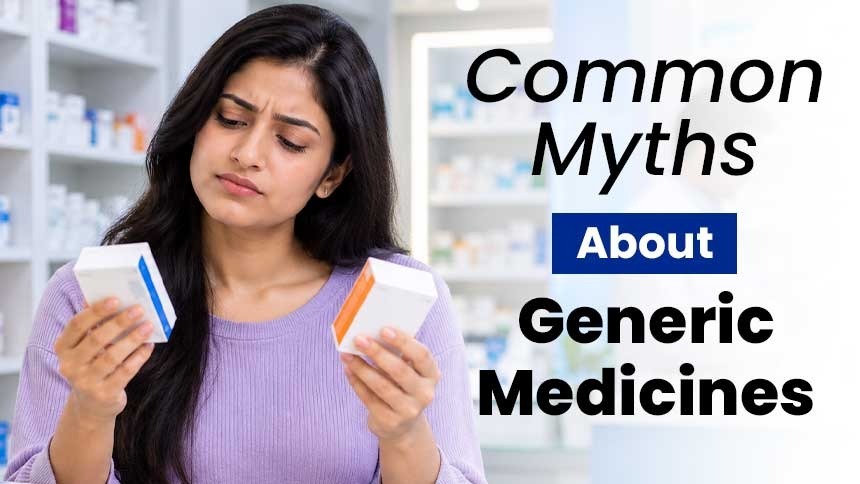
The active ingredient in a generic medication is the same as the active ingredient in the brand-name medicine and meets the applicable regulatory requirements for quality, safety and efficacy before being used by consumers.
A difference in price, packaging or appearance is not what actually differentiates the effectiveness of a medicine. This evidence-based guide tackles some of the most common myths about generic medicines and provides facts, backed by medically accurate information, to help you better understand them.
Why Are Generic Medicines Often Misunderstood?
A very common reason generic medicines are misunderstood is that they differ in name, packaging, colour, and shape from branded medicines, and they are much more affordable.
People often think that a lower price equals lower quality or think that if a medicine looks different, it must not be as effective. Generic products are manufactured as per the regulatory requirements, and the products comply with the relevant quality, safety and performance standards. These requirements will help you differentiate between facts and myths.
10 Common myths about generic medicines
Myth 1: Generic Medicines Are Less Effective Than Branded Medicines
Fact: Generic medicines are made to be as effective as the brand-name medicines.
Generic medicines contain the same active ingredient, strength, dosage form and route of administration as the reference branded medicine. They must pass bioequivalence tests, which prove that the generic medicine is released into the body at a similar rate and amount as that of a brand-name medicine. This applies to multiple medicine categories, such as antibiotics, hormonal tablets, sex tablets etc.
Myth 2: Generic Medicines Are Made With Lower-Quality Ingredients
Fact: Generic medicines are produced with high-quality ingredients that pass multiple checks and meet regulatory standards before being processed.
Active pharmaceutical ingredients (API) and excipients in generic medicines are tested for their purity, identity and residual matter, similar to brand-name medicines. The manufacturer is supposed to practice Good Manufacturing Practice (GMP) and strict quality control during the manufacturing process.
Myth 3: Generic Medicines Are Not Safe
Fact: Generic medicines comply with safety standards before they are approved for use.
Generic medicines are tested for quality, safety and effectiveness by regulatory authorities before approval and sale in the market. Manufacturers also have quality systems to help ensure consistency in production. Generic medicines must be taken under the guidance of a doctor, and the safety precautions must be followed.
Myth 4: Generic Medicines Take Longer to Work.
Fact: Generic medicines are made to work for the same expected time as brand-name medicines.
Generic medicines go through bioequivalence tests, which demonstrate that they are equivalent in performance to the brand-name medicines. Generic medicines with the same salt are prescribed for the same indication as their branded equivalents.
Myth 5: Doctors Don’t Recommend Generic Medicines
Fact: Many doctors prescribe or recommend generic medicines when clinically appropriate.
The choice of medicines depends on the doctor’s assessment of the patient’s health, what treatment they want, what medicines are available and the clinical guidelines. Hospitals, clinics and public health programmes use generic medicines since they provide clinically appropriate medication.
Myth 6: Cheap Generic Medicines Mean Poor Quality
Fact: Low-cost generic medicines are not necessarily poor-quality medicine.
The reason generic medicines cost less is that the makers don’t have to spend money on the research and marketing that the brand-name medicine does. Price differences are mainly due to market competition and business models, rather than differences in manufacturing quality.
Myth 7: Generic Medicines are Copies with No Quality Testing.
Fact: Generic medicines are subject to regulatory and quality testing before they are approved.
Generic medicine manufacturers are supposed to be compliant with relevant Good Manufacturing Practices (GMP), have documented quality systems, and conduct quality checks throughout the manufacturing process. Appropriate evaluation, including testing for identity, strength, purity, stability and bioequivalence (where applicable), is carried out on generic medicines before their approval. The requirements are designed to assure the medicine is consistently of high quality.
Myth 8: Generic Medicines Have More Side Effects Than Branded Medicines
Fact: The safety profile is expected to be the same for generic medicines as for brand-name medicines because they contain the same active ingredient.
No, generic medicines do not have more side effects than branded medicines. Most expected side effects and the therapeutic effect are due to the active ingredient and individual patient factors. If there are any unusual effects, patients should consult their doctors.
Myth 9: Generic Medicines Are Only Suitable for Minor Health Problems
Fact: Generic medicines are also used to treat common chronic disorders as per the patient’s requirements.
Generic medicines are also used to treat chronic disorders like hypertension, diabetes, high cholesterol, thyroid, and others. Decisions on whether to use a branded medicine or generic medicine are largely based on the severity of illness, the condition of the patient and the analysis performed by the doctor.
Myth 10: You Can Switch to a Generic Medicine Without Checking With a Doctor or Pharmacist
Fact: Generic medicines contain the same active ingredients and therefore should be used or switched only after the guidance of a doctor.
A doctor or pharmacist can confirm whether the generic medicine is appropriate for your prescription, dose, and health needs. This is important for medicines that require close monitoring or have specific dosing instructions. Avoid changing or stopping prescribed medicines without professional guidance.
How Zeelab Pharmacy Supports Access to Quality Generic Medicines
Zeelab Pharmacy adopts a quality approach to sourcing medicines by collaborating with manufacturers who meet the relevant regulatory requirements and recognised manufacturing standards. The company emphasises quality assurance, regulatory compliance and consistency in its products throughout the sourcing and distribution process. The company also performs independent quality testing to ensure the safety of medicine.
The company’s goal is to provide its customers with better, more affordable quality medicines by optimising sourcing and distribution. Operational efficiencies bring down the cost of goods but do not reduce applicable quality standards.
Zeelab Pharmacy is operating with a growing chain of company-owned stores, franchise pharmacies and an online platform. It is working to increase access to quality branded-generic medicines in various geographies of India. This wider access enables consumers to obtain essential medicines and healthcare products more easily and affordably, while continuing to prioritise quality and affordability.
Supporting Better Healthcare Through Generic Medicines
Generic medicines are an important part of modern health care, offering multiple treatment options and improving access to essential medicines. Correct knowledge about generic medicines, based on scientific information, helps consumers make informed choices about their medicines. Once authorised by the appropriate regulatory bodies, generic medicines must be of high quality, safe, and effective and therefore are a trustworthy substitute for brand names.
As more people become aware of generic medicines, they can discuss the options with their doctor and pharmacist to ensure that they receive the medicines that are best for their health. Choosing the best medicines from trusted pharmacies that provide quality-assured medicines can enhance access to affordable health care while maintaining applicable standards and improving the healthcare system as a whole.
